In Architecture of the Evicted, Rosalyn Duetsche informs that " ...redevelopment is structured on relations of eviction by means of which its stability comes into existence" (160). I never fully thought about homelessness and how or why it happens before reading this article. One part of homelessness is a result of eviction from apartment buildings, parks, etc. A redevelopment of a particular area occurs and suddenly your precious home is taken over or you can no longer afford to pay rent to keep living there. I cannot seem to wrap my mind around how that can possibly be morally right.
A high prosperity or a new "hot-spot" area, results in an uneveness. Uneveness leads towards homelessness due to the influx in cost of living in that particular area or a new construction project where they can no longer stay due to safety hazards. Deutsche states in her article that " ...structuring does not represent a neutral solution to objective problems. The reverse is closer to the truth" (151). Restructuring helps homelessness in a negative view causing the high-end, luxury residents to bump the rest of the people in that area onto the street. I would think the government would be against this since it raises numbers of the homeless, but how is it avoidable or does the government really even care since the new "hot-spot" is bringing in more money? It is an endless cycle that is dominated by redevelopment.
Kocur, Zoya, and Simon Leung. Theory in Contemporary Art since 1985. Malden, MA: Blackwell Publishing, 2005. 151 & 160. Print.
Wednesday, April 7, 2010

Re-evicting the already evicted.
I read Rosalyn Deutsche's article "Architecture of the Evicted", and inferred ultimately that when a run down urban area is re-furbished it creates problems, often displacing those who lived in said area. "Only by recognizing that the effects of redevelopment in individual urban spaces are not circumscribed but radiate outward and that redevelopment projects are part of larger, indeed global, spatial patterns can we discern, beneath the appearance that gentrification is random and spontaneous, its systematic character and extensive proportions" (153). I do not understand how redevelopment projects affect spaces globally, let alone evict people in the immediate space. Perhaps I am just naive.
My grandmother, Tally Sweat, is the president of Olmsted Linear Park Alliance in Atlanta. This is a successful restoration of a park that gives back to the community. $9 million was raised for the restoration of this park. It was not federally funded, so it could not have had a negative economic impact. It may have displaced the homeless during the construction period. Again, I do not see a negative. Deutsche states, "The homeless must therefore be evicted not only from redeveloped spaces but also from the image of redevelopment" (156). I find it interesting that Deutsche uses the verb "evicted". Are the homeless not homeless because they were once evicted to begin with? So now they are re-evicted? And then evicted again from the "image of redevelopment?" The homeless weren't part of the original image of the park, so why should is there a focus on them being evicted from an image they were never meant to be a part of?
Rosalyn Deutsche. “Architecture of the Evicted.” Theory in Contemporary Art since 1985. Ed. Zoya Kocur and Simon Leung. Malden, MA: Blackwell Publishing, 2005. 150-165
Rosalyn Deutsche's "Architecture of the Evicted" focuses on city projects of restoring sites to emphasize historic elements and to "restore - against disruptive forces - a model city from the more remote past, one that is harmonious in its entirety" (Deutsche 151). She reveals, however, that these "restorative" efforts do not truly succeed in returning the city to a purer, more original state, but transform the areas of the city into centers of luxury facilities for housing, business, and recreation which are most accessible to the rich, "gentrification," and "destroy the physical conditions for survival - housing and services - for redundant blue-collar workers" (Deutsche 152). Of course, such projects would drastically raise property value and force unwealthy tenants out of their housing, but the purpose behind them is ultimately flawed. The city is stable and functional (or at least stable in that it is supporting the citizens that it is) before this restoration/gentrification process. Altering the city to anyone's ideal (in this case the ideal of the rich, whose class is funding these alterations) disrupts the city's current functionality.
Deutsche is obvious concerning her admiration of the work of Krzysztof Wodiczko, whose work includes large-scale projections that reveal the true effects of these urban projects. Some particular sites of these projections actually include art galleries and museums. What is here somewhat distressing is that the presence of art galleries is actually considered to be part of these city appearances the marginalize those of a low class. Art is not considered to belong to the public but only to the rich, whom its presence will attract: "It displays to future luxury tenants the high-status as well as high-income character of the area. More, the museum creates an image of redevelopment as a whole, legitimating it as a positive force that brings cultural benefits to all New Yorkers" (Deutsche 153). "High-Culture" is only the culture of the rich. I think this ads another layer of meaning to Wodiczko's projection onto the New Museum of Contemporary Art, which took the form of giant locks and chains around the building, revealing that the location being "restored" would not belong to the current population. Indeed, they would effectively be unwelcome and forced out of the area. But the building, a contemporary art museum, being off-limits to the entire population, reveals by Art's very hand that art is not made for everyone. It is a self-damning message that intends to subvert itself and its peers and create a new order that it cannot be a part of and still be recognized, given the current order.
Laylah Ali and Place

According to Robertson and McDaniel, "the place or places where one has lived with their attendant physical, historical, and cultural attributes, condition what one knows and how one sees" (Robertson, 151). I completely agree with this statement, and it reminds me of an artist that I have studied in the past named Laylah Ali. Ali's work does not directly deal with place, but it was something that had a major impact on her work.
Laylah Ali produces Gouache paintings that reveal racism and dominace. In her "Greenheads" she ususally shows one figure overpowering other figures. She shows violent scenes of "greenheads" killing each other. But why does Ali show this?
Growing up in Buffalo, New York, Ali experience "an interesting, post-industrial place, with a longt racial history" (Young, 7), had a major impact on her as a child. In the sixties and seventies, Buffalo was a very segregated city and because Ali comes from not only a very poor family, but an interracial family as well, she had a difficult time fitting in at school and even in her own neighborhood. The place where a person grows up can have a huge impact on how they view the world and those "places contain metaphoric or symbolic meaning that go deeper than the surface appearance of a particular landscape or architectural style. Societies transform place, imbuing them with memories, histories, and symbolic significance" (Robertson, 153). The image above shows the impact of what not only Ali went through in New York, but what many other African Americans went through. Sometimes in her work she shows witnesses, which refers to instances where terrible things happened in her community and people stood by and watched the violence happen. They would not say or do anything. The bullying that Ali experienced in her community really impacted her work and it clearly shows. The place where we grow up has everything to do with how we view the world.
Bibliography:
Robertson, Jean and Craig McDaniel. "Themes of Contemporary Art". Oxford University Press. 2010. pg 151m 153.
Young, Kevin. "An Interview with Laylah ALi" Laylah Ali Note Drawings. DeCordova Museum and Sculpture Park. 2008 pg 7.
Tuesday, April 6, 2010
History and the Artificial
In “Architecture of the Evicted,” Rosalyn Deutsche points out the artificiality of urban redevelopment programs and the exercise in power that drives them. She claims that despite the good intentions of developers and supporters, projects to restore places to previous conditions “rarely …actually return their sites to an earlier, and certainly not to an ‘original,’ state” (Deutsche 150). Moreover, the project might say more about present problems than past solutions: “they refurbish antique details while extensively reconfiguring space in accordance with the exigencies of our own historical conjuncture” (150). Together these factors motivate an effort to create “a model city from the more remote past, one that is harmonious in its entirety” (151). The problem is that this effort is based on a limited view of the past. Different social groups can view the same scene from history with opposite attitudes. Deutsche notices that when the group in power seeks to restore the past, they are remembering what “they” like about the past and how the project might serve their present needs – “refortifying spatial hierarchy” (158). Like a Disney movie, this perpetuates a biased and flawed view of the past “by obstructing the perception that the forms, uses and meanings assigned to space fulfill the needs of specific societies structured on relations of power” (158).
The careful artist might consider these issues when dealing with history, such as the proposed murals for the new federal courthouse in downtown Tuscaloosa. The murals are meant to “chronicle West Alabama’s past and present” (News 1). The artist, Caleb O’Connor, “requires a great deal of research…to gain insight about the area's layered history. From the Civil War and Trail of Tears, to the Civil Rights Movement, University of Alabama football and modern industry…” (News 2). Such measures are appropriate and helpful, but should not be understood as binding the works to reality. The first mural points out the artificiality of the project, with Paul “Bear” Bryant crossing the street in front of President Witt on a picturesque day in front of Denny Chimes. This is not meant to say that the murals are wrong, but rather that viewer should not automatically trust any painting to be absolutely right.
Rosalyn Deutsche. “Architecture of the Evicted.” Theory in Contemporary Art since 1985. Ed. Zoya Kocur and Simon Leung. Malden, MA: Blackwell Publishing, 2005. 150-165
Boyd, Ashley. “History Comes to Life.” Tuscaloosa News. 19 March 2010. Web. 6 April 2010. http://www.tuscaloosanews.com/article/20100316/NEWS/100319709?p=1&tc=pg#
The careful artist might consider these issues when dealing with history, such as the proposed murals for the new federal courthouse in downtown Tuscaloosa. The murals are meant to “chronicle West Alabama’s past and present” (News 1). The artist, Caleb O’Connor, “requires a great deal of research…to gain insight about the area's layered history. From the Civil War and Trail of Tears, to the Civil Rights Movement, University of Alabama football and modern industry…” (News 2). Such measures are appropriate and helpful, but should not be understood as binding the works to reality. The first mural points out the artificiality of the project, with Paul “Bear” Bryant crossing the street in front of President Witt on a picturesque day in front of Denny Chimes. This is not meant to say that the murals are wrong, but rather that viewer should not automatically trust any painting to be absolutely right.
Rosalyn Deutsche. “Architecture of the Evicted.” Theory in Contemporary Art since 1985. Ed. Zoya Kocur and Simon Leung. Malden, MA: Blackwell Publishing, 2005. 150-165
Boyd, Ashley. “History Comes to Life.” Tuscaloosa News. 19 March 2010. Web. 6 April 2010. http://www.tuscaloosanews.com/article/20100316/NEWS/100319709?p=1&tc=pg#

I found this week's reading to be considerably more accessible than that of previous weeks. The theme of place in art is highly evident in nearly all branches of art history. Relating the idea to my own earlier work as a photographer (working mostly with landscapes in rural areas of Alabama) it is especially easy to relate with, as the camera becomes a tool to relate a place to the viewer, a way to capture a feeling evident to yourself at the time. I enjoyed the selected biographies of artists who work with place as a theme. Janet Cardiff and George Bures Miller's The Paradise Institute seems to be an extension of John Cage's 4:33, using the sounds of ambiance to create a distinct mood within a place: "Because the noises are so faithful to what one would expect to hear at the cinema (shuffling feet, the sounds of people taking their seats), disbelief is willingly suspended." (180) Cardiff's use of sounds, space, and setting recreate an eerily common experience, while being slyly manipulated (tidbits of conversation, the movie plot, etc...).
The thorough experience created by Cardiff's Paradise Institute brings to mind the necessity of it. Does the artist really have to go to such lengths to express her ideas?: "...Whether an event is quotidian or mysterious and dramatic, the place where the event occurs colors and shapes our understanding of our experience...Our experience of place, its physical and emotional specificity, is the leitmotif of Cardiff's art."(182) I feel the emotional response she is seeking can be provoked in a much more subtle manner, for example, the smell of cold, wet pine needles instantly brings to mind a rushing reminder of the year I spent living in Decatur, AL (because apparently that's the only impression it left on me). A good photograph can put you entirely within a space just by looking at it. Certain music can instill a sense of nostalgia and put you in a very specific mood. Perhaps the great lengths Cardiff goes to is to create a universal feeling that relates everyone to a familiar experience in a place. Then again, every one's individual understanding of the place is different, making a universal understanding impossible; something pointed of by what we've learned in class about deconstructionist theory.
image: http://images.artnet.com/artwork_images_423861818_269302_janetcardiffandgeorgebures-miller.jpg
Robertson, Jean, and Craig McDaniel. Themes of Contemporary Art. Second. New York, New York: Oxford University Press, 2010. 179-182. Print.
Monday, April 5, 2010
Kerry James Marshall
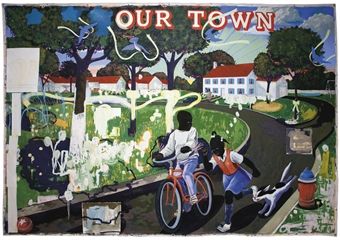
A famous contemporary African American artist named Kerry James Marshall was born in Birmingham in 1955 (Marshall). Most of his work referenced the geography of his upbringing: You can’t be born in Birmingham, Alabama, in 1955 and grow up in South Central [Los Angeles] near the Black Panthers headquarters, and not feel like you’ve got some kind of social responsibility”(Marshall).
In response to Kerry James Marshall’s quote, was his social responsibilty to represent a group of people, or the places in which he grew up? I think Marshall’s referencing both the people and locations that surrounded him growing up. Everyone is a product of their environment. “Place can be a central facet of someone’s idenity” (Roberston, 151). Regardless of how one feels about the people they interact with, eventually these people will influence one’s decisions, ideals or beliefs. Many of Marshall’s works depict people living in housing projects. Rather than focusing on the violence and poverty within these projects, he emphasizes the people who live within these developments. Although the conditions are not ideal, people spend time developing friendships and families within these projects.
Marshall’s “Our Town” shows two African American children playing in what looks to be a “white” neighborhood. The homes, yards and streets are beautifully maintained. This work shows his exaggerated black figure. His paintings have a whimsical quality through the use of curvy lines and vibrant colors. In “Our Town”. Marshall’s display of children running and riding bicycles through the white neighborhood shows the segregation during the Civil Rights movement. Neighborhoods were seperated by race. “The place or places where on has lived, with their attendant physical, historical, and cultural attributes, conditions what one knows and how one sees” (151). Kerry James Marshall’s upbringing within housing projects, influences his artwork. His lived experiences help him convey important stereotypes and truths about these locations during the civil rights era.
Marshall, Kerry James. "Art:21." PBS.org. N.p., 2007. Web. 5 Apr 2010.
"Our Town." Storage.Canalblog. Web. 5 Apr 2010.
Robertson, Jean, and Craig McDaniel. Themes of Contemporary Art. Second. New York, New York: Oxford University Press, 2010. 151. Print.
Subscribe to:
Posts (Atom)
