Search This Blog

Wednesday, February 3, 2010

Race ?

In order to adequately respond to the week's subject, I feel I must begin with the age-old question. Race. What is it? As Andrea Roulaine defined in her post, race "refers to the categorization of humans into populations of groups on the basis of various sets of heritable charactersitics." I would like to add a cultural aspect to this: race, as we understand the word to work in application, must also include cultural conventions and traits specific to the group under consideration--a skin color AND a practice.

I'm sure by now we all understand the intrinsic worthlessness of trying to define gender. In that same vein, it stands to reason that all aspects of "racial identity" are equally insubstantial on a personal level. If Derrida is to be believed, then social and cultural identity is a thing continuously defined, a thing that is yet to be defined. Therefore, it can have no true definition.

So then, can race be made of skin color?

Let us consider Adrian Piper's Cornered. Piper speaks authoritatively in front of a group of empty chairs (of course, viewers were invited to sit). Through the pre-recorded video, she calmly speaks the to the triangle on the issue of "blackness" as they simultaneously back her into a corner. Still, Piper's message does not resonate with me as it does with her (while I can empathize, I will never fully understand the experience of another person outside myself )-- her words open to an unending cycle of contradiction and indefinition. I agree that many people have African blood in them. Does this make them black, even if they choose to acknowledge it? Can racial identity be that simple to organize? Piper herself states that "if someone can look and sound like [her] and still be black, then no one is safely, unquestionably, white" (Piper 184). If this is true, then the opposite must also be true--no one can be safely, unquestionably black. And if this seemingly Caucasian woman can tell us she is 100% African American, then what can her skin color possibly have to do with it? With this, Piper uncovers not only the arbitrary nature of the vilified "other", she proves that the concept of "other"--and thus her fringe position, her superficial (read: cosmetic) racial identity--does not exist at all, despite the fact that she is still forced to occupy it.

Since skin color cannot possibly be THE deciding factor, can the definition of race be supported by culture?
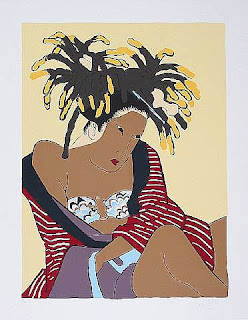

Iona Rozeal Brown, Untitled (Female), 2003. Sragow Gallery.


Iona Rozeal Brown is an African American artist who works with the idea of cultural appropriation. Most notable is her work exploring the cultural combinations devised between American and Japanese societies, the use of hip-hop as identity being the definitive aspect of her work. She sees the Japanese appropriation of hip-hop culture as "superficial gloss" while she herself borrows artistic styles of traditional Japanese ukiyo-e prints, juxtaposing their "concepts of manners and attitudes" with her own (Williams 827). Brown thus uses her incomplete understanding--incomplete in the sense that she is a cultural outsider--of Japanese art to convey their own misunderstanding of African American culture. The subjects of the paintings "are a sum of all of these parts that are believed to define blackness/coolness" (Williams 829).While she acknowledges that appropriation can be used with positive results if both cultures understand what informs their own identities (Williams 831), Brown points out that appropriating a culture is not what it means to be black.

If these two contributing factors alone cannot identify race, race must be, as Charles A. Wright writes (tee hee), relegated to a question of transgredience--the instantaneous moment of recognition that the person before me is outside of myself (Wright 200), and therefore an oppositional other. Yet anything can exist as this oppositional other (a culture, a government, a collegue, a sibling), so marking a single race special in that manner is again, arbitrary: the practice is without merit.

Yet no one would argue that it didn't exist. Is it then a mix of both skin and culture that identifies a race? At what mix of either can identification occur? Or can we now even define it, especially if that definition changes with each attempt to define, with each shift of our perception and understanding? If it cannot be defined, then how can it be defended? And, most importantly, how then could it possibly be attacked?

I understand that this response takes an overly simplistic view of race and racial identity. I submit that the complexity of the issue and my own understanding of it severely limits a fully critical response. I also do not want to give the impression that I feel there is no such thing as difference or that race cannot necessarily be celebrated. I merely wish to demonstrate that the tools a minority artist uses to uncover the arbitrary and unjust institution of racism can destroy the seat of power (aka the coveted position of "White Male American")in the dualistic relationship, and by erasing one half of the dualism, by definition, the other must also cease to exist.


Piper, Adrian, "Cornered: A Video installation project (1992)", Theory in Contemporary Art since 1985, Malden: Blackwell Publishing, 2005. pp 187-203.


Williams, Lyneise, "Black on Both Sides: A Conversation with Iona Rozeal Brown", Project Muse, 2006. pp 827-833.


Wright, Jr., Charles A., "The Mythology of Difference: Vulgar Identity Politics at the Whitney Biennial", Theory in Contemporary Art since 1985, Malden: Blackwell Publishing, 2005. pp 187-203.

Race


Kara Walker is a contemporary African American artist whose artwork focuses mainly on race, identity, and the struggle for power. Her move from California to Georgia at a young age had a huge influence on her work, because she became more aware of her “blackness” while living in the South. She is most famous for cutting out enormous silhouettes of people from black paper and mounting them on walls. In these works, Walker exaggerates stereotypical black characteristics, and the figures are dressed in costumes from the antebellum period (Biography). Her work has been highly criticized by all races, but she continues to support and depict the notion “that American identity, black as well as white, is rooted in finding pleasure in racist brutality” (Arnason and Mansfield 739).


Walker fights the idea of the “mythologically constructed ‘straight, white, male’—the preeminent protector of culture” by distorting history and depicting slaves dressed in elaborate antebellum gowns (Kocur and Leung 190). She suggests that these pseudo historical works are a symbol of inaccuracies in the actual history of African Americans (History). Walker’s exaggerated features and depictions of “pikaninnies and sambos” prove that viewers who identify these figures as African American are succumbing to the stereotypes created by white people (Arnason and Mansfield 739). She further suggests that race is not only a problem for black people, because stereotypical identities of all races still exist. There will be a struggle until stereotypes can be forgotten, and like Adrian Piper stated in our reading, “It’s our problem to solve” (Kocur and Leung 186).


Arnason, H.H., and Elizabeth C. Mansfield. Histoyr of Modern Art. 6th ed. Upper Saddle River, NJ: Prentice Hall, 2010. 739. Print.

Kocur, Zoya, and Simon Leung. Theory in Contemporary Art since 1985. 1st ed. Malden, MA: Blackwell Publishing Ltd, 2005. 186-190. Print.

"The Art of Kara Walker: Biography." Walker Art Center. 2007. Walker Art Center, Web. 3 Feb 2010.http://learn.walkerart.org/karawalker/Main/Biography .

"The Art of Kara Walker: History Collusion of Fact and Fiction." Walker Art Center. 2007. Walker Art Center, Web. 3 Feb 2010. http://learn.walkerart.org/karawalker/Main/HistoryCollusionOfFactandFiction.

Tuesday, February 2, 2010

Hip Hop Culture Vs. Society

Iona Rozeal Brown states in her "Black on Both Sides" interview, "Lots of rhymes, boasts, and bragging about clothing, jewelry, cars, and such, but that is not the only subject matter of hip-hop" (832). Brown states in words, what is trying to be portrayed in Fahamu Pecou's painting "Blak is the nu blak". Pecou is an artist that shows how society can continually be caught in the ongoing process of materialism and race. Beginning with photo shoots of himself, Pecou then paints the reoccuring scene. The scene is a critique on society and how much people are affected by it. Brown states over and over again, how society needs to see more than the emphasis of stereotypes society places on culture of blacks, that there is more than money, music, and fame.

Pecou, an artist like Brown, finds humor on a serious topic that is prevalant in today's society. In "Blak is the nu Blak", Pecou portrays himself as a rich, young black male dressed nicely in a suit with a fancy car. Ironically, the title of the painting is addressing the racial issue that is portrayed by society. As Adrian Piper states in "Cornered", "...if someone can look and sound like me and still be black, then no one is safely, unquestionably white" (184). Piper addresses the issue of the majority of people in America are black. If this statement is correct, then why is white not seen as the minority and the stereotype of black cultural not seen as a positive view?

Kocur, Zoya, and Simon Leung. Theory in Contemporary Art since 1985. Malden,
Massachusetts: Blackwell Publishing, 2005. 184. Print.

Williams, Lyneise. "Black on Both Sides: A Conversation with iona roseal brown." Project Muse (2006): 832. Web. 3 Feb 2010.

What is The Message?

Adrian Piper’s Cornered was a 1988 video installation which had Piper discussing why the viewer may be black and asking what they would do about that realization. Piper claims that “this country’s [U.S.A.] entrenched conventions classify a person as black if they have any black ancestry” (184). Because most Americans due indeed have some black ancestry, most Americans are black. Underneath the video screen lies a table on its side with its bottom facing the audience, this seems to suggest that we, the audience, are all pushed under the table, a metaphor for disadvantaged peoples. Moreover, the even somber tone of Piper’s dialogue gives a serious mood to the work, causing the viewer to listen with a certain reverence. In closing the monologue she asks the viewer “What are we going to do?” about some people identifying themselves as black while others choose not to (186).
But what is Adrian Piper actually trying to say with this work? Is she trying to unify people under a belief of race being a social construction? Is she trying to reveal racist thoughts in the viewers by their reactions to her questioning? Piper does seem to exhibit both of these motivations. By pointing out that anyone could be black by having “between 5% and 20% black ancestry” she seems to take the “otherness” out of being black.(184) In contrast, she also seems to be trying to reveal racist attitudes by eliciting answers to questions. How would a white racist react to being identified as black? Whatever the message though it is clear that racial identity was a major motivation in this work.

RACE


What is Race? Well, according to the encyclopedia, usually refers to the categorization of humans into populations of groups on the basis of various sets of heritable characteristics. In other words, all that separates us from each other is our characteristics, our appearance. But because of these physical differences in appearance a social status has evolved in America. Artists along with many others, though out the years have tried to break away from this way of thinking and to make us question this social status that has developed. Chris Burden's installation Fist of Light ( 1992-3) was a good example of how society ignores the diversity and is fixed on only seeing one color. It constituted a proposal for a sealed, air conditioned chamber housing more than a thousand 500-watt light bulbs, the goal being " to totally saturate the entire space with light, attempting to remove all color in a visual analog of fission" ( Kocur and Leung 201). Our society has tried to remove the color, the variety from American culture, the favor. It only wants us to recognize the whiteness. Is society so blinded by this whiteness that we cannot see and accept anything else? The variety, the absent of sameness, that is the true ideal image. Its the differences that bring about this true image. And what is whiteness anyway? Who came up the this term, or any term of race? The differences is what makes up our society, it is what makes us a part of each other. Adrian Piper states that in fact, some researchers estimate that almost all purportedly white Americans have between 5% and 20% black ancestry. ( Kour and Leung 184). So does this mean that their is no such thing as white? That we are all just a combination of each other? And in that being said, what is race again?
Kocur, Zoya and Leung, Simon. Theory in Comtemporary Art since 1985.
1st ed. Malden, MA: Blackwell Publishing Ltd, 2005 184, 201 Print.

Adrian Piper: Cornered 3


Conceptual artist Adrian Piper is well known for introducing her particular ideas of race and gender into the world of conceptual art. In Cornered, the viewer is shown a well dressed woman: Piper, in a TV screen directly in front of the audience. She begins her piece by making the statement “I’m black. Now, let’s deal with this social fact, and the fact of my stating it, together” (Kocur 182). This original statement sets up the whole course for the entire conversation that Piper has with her audience; and conversation is what she has. The way the installation is set up, the viewer is sitting in a chair, directing facing Piper, while she is sitting at a table facing the viewer allowing for an intimate feeling. That this piece is to be a dialogue between Piper and ourselves is understood right from the beginning: the artist is communicating her beliefs directly to us, using words.


Throughout her conversation with the viewer, Piper never raises her voice; instead she prefers to speak softly and slowly, allowing for emphasis on certain parts. She discusses the problems that are raised within our society by forcing people to join our racial clubs, and that by refusing to join ours, what questions she is thus bringing to the table. In today’s society, we prefer not to discuss race, and within her first sentence, Piper is not only discussing it, but rejecting her white identity. She says to the viewer that it is this rejection that is seen to society as her being hostile to Caucasians, and that we (society) believe that it is better to just leave race out of it, or that it’s “inherently better to be identified as white” (Kocur 182). But it is these racial identity questions that Piper is constantly asking. That while she is saying that she is black, she states later on that she is also white, confusing the audience members. Piper believes that without direct statement, the common belief is that the person’s identity is white. That it is only once directly stated that a person becomes black. Her question to society is why should this be? Why should a person have to state their identity for it to be understood, especially when the majority of Americans have African American heritage yet they do not count themselves as black (Kocur 184)? She asks the audience to decide for themselves, what their identity should be. Do they follow after society and let others figure it out for them, or do they capture it and own their own?


"APRAF: Adrian Piper." Welcome to the APRA Foundation. Web. 02 Feb. 2010. .


Kocur, Zoya, and Simon Leung, eds. Theory in Contemporary Art since 1985. Malden: Blackwell, 2005. Print.

Monday, February 1, 2010

Piper's Corner

"I'm black. Now, let's deal with this social fact, and the fact of my stating it, together."(Kocur 182) This statement from Adrian Piper's installation "cornered" immediately grabs the attention of the racially conscience viewer, who is assumed to be white. The remainder of the dialogue seems bent on digging into the (white) viewer's subconcience guilt and attempts to turn the table on them: "In fact, some researchers estimate almost all purportedly white Americans have between 5% and 20% black ancerstory."(Kocur 184) What does this actually mean to the viewer? Does she assume that all whites view the idea of being black as a negative, or that blacks view the idea being white a positive? This is followed by a slew of questions demanding what this white viewer will do about their new found racial heritage.


After all the questions and accusations Piper puts on the viewer, I find myself to be unimpressed by the shallow assumptions she makes for myself and caucassion people in general. Although I can certainly appreciate her blunt and straightforward approach, I think these somewhat condescending generalizations about whites feeling embarressed or offended upon having their ancestory questioned is of very little value in the understanding of race issues in America. Her imagined scenario of a white person feeling pressure of coming out of the "caucassion closet" is simply not applicable to every white person's view on race equality. I can't claim to be totally free the natural tendency of making assumptions about about a person based on their apperance, but her assuming the I think race, and race alone is a damning attribute of a person is extreme at best. Few people I know would think about it as anything more that just an interesting example of the racial blending common in this country. Why would I care about having a pure racial background, if there is even such a thing? I have no idea what entirely consitutes my racial background, so what assumptions about myself do I have to cling to? I don't feel Piper wishes to deal with anything other than attempting to "corner" the white viewer into her demands for guilt or shame. 


Kocur, Zoya and Leung, Simon. Theory in Contemporary Art Since 1985. 1st ed. Blackwell. 2005. 182-186.